Seven years ago, I did a self-reflective exercise on death. However, instead of writing an obituary, I used my imagination to transfer myself to the day I will die. I pictured all my accomplishments and everything that I dreamed of: having the wedding of my dreams (I was engaged at that time), having children, a nice house, a bank account with enough, my family around, and everybody health and happy. In all of that, I didn't feel complete or happy, instead I felt a deep pain in my chest that even gave me a bitter taste in my mouth. From all my goals and dreams, there was one main thing (the most important one) I hadn't achieved: what I believe God called me to do. Due to my religious background, death to me is not the end, but the beginning; and life, to me, is all about that beginning. I feel that my call is to help other people, so that day I changed my life completely to that purpose and since then my main goal is to help other people. I got married and indeed had the wedding of my dreams, but my husband has the same goal as mine, and we are making the effort to achieve that.
Death has come close to me more than I expected, first during a intense airplane turbulence that made more than half of the passengers to throw up or pass out. Second, when my husband was deployed and I received phone calls or messages of incidents in his team. And third, when I started to work in a nursing home. My husband and I engage in some high risk sports to challenge ourselves and in the end I think it helps me to control fear; stress management. The book calls it an attempt to overcome death anxiety - I never thought that was what we were doing.
We also talked about having a durable power of attorney for health care decisions, just so in case of dispute, such as what happened in Terri's case, we wouldn't have any problems. I think our biggest concern is not about death itself, but if we are incapacitated to make our own decisions. And I can understand that because I have patients that are in hospice/comfort care - some conscious and others not due to pain medication. At a point they are not responsive anymore, so we do our best to provide comfort. In one case, a patient was begging for his life and he held my hands as if I could pull him out of his pain. Medication did not help, even morphine didn't work. Unexpectedly, he was comforted only by religious music. It calmed him down, and at that night he passed away, apparently in peace, having his family around.
I try to avoid my emotions getting the best of me, but I always feel the loss of any patient. I hold my thoughts during my shift and after that I come home and seek comfort from my husband or family. I go through a short period of bereavement. I don't think I'm used to death or that I'll ever be, but I find relief to think that I can provide dignity and comfort for those who are facing it.
Friday, June 13, 2014

Monday, June 9, 2014
Retirement
Although
chapters 14 and 15 covered a great deal of biological and cognitive functions
related to the aging process, which always catch my attention, the article “As
Good as it Gets” was my main focus of this week. This article attracted my
curiosity due to the sharp tone of the writer. The way I read the article could
be summarized in the words of Professor Gerard F. Anderson of the Johns Hopkins
Bloomberg School of Public Health: “'The European attitude is, we're all in this together and
sooner or later we're all going to become older and need some help. The U.S.
attitude is, we're all rugged individualists and we're going to take care of
ourselves, not others”
It’s more compelling
to see retirement and quality of life for the elderly as the focus of this article. But, I’m not sure about that. Mostly, because AARP
is a main advertiser of health insurance for seniors, and though it is a
non-profit group, their $458 million in health insurance revenue in 2011 might
claim differently.
Anyways, the article
goes through the success of Netherlands’ healthcare and retirement system, and
how the elderly are living so well over there in comparison to Americans. It’s true that the Dutch system of converting
workers’ pension’s reserves into an annuity upon retirement seems to work
better than the defined contribution plan (such as 401K plans) practiced by most
Americans. The duality that I see here is government retirement safety versus
employee’s participation and contribution decisions. In my opinion, retirement
boils down to one point: saving for later; whether this is ‘saving’ through
taxes and federal mandatory contributions under heavy government management, or
saving in private bank accounts and investing the money as each person believes
is the best way.
Furthermore,
I agree that the healthcare system needs health competition, so leaving it
solely to business or to government will not end up well. A
balance sounds like a better deal for everybody. Nevertheless, this is not a
political post, so I’m not going to spend much time talking about healthcare
reform. Instead, my main point about this article is that for a fast aging
population that is living longer, and will have less active workers to support
the retirement system costs, there is no easy and comfortable solution. As exemplified
in the article, “In Sweden, with its low
birth rate and increasing number of pensioners, experts estimate that by 2035
the system will be seriously out of balance, with only about two workers
supporting each older person.” Then, it’s just pure math to
figure it out that system will fail as much as the American system might too.
Truth is that the elderly are facing and
will face an even greater stress when it comes to retirement, which will
contribute negatively for their mental and physical health. I think portraying one's country retirement success momentum is deceptive for a long term solution, and that's why I don't agree much with this article.
Monday, June 2, 2014
Middle adulthood
Since I'm in my early 30's, I think chapter 12 was really something I can relate to. For over 10 years I've worked with software, and by 27 years old, I was already an IT project manager. I made fairly good money and felt that I had a good job, but the idea of just becoming more senior in my profession made me feel...empty.
Then, I met my husband. We happily got married and my life changed completely when I moved to U.S. I had to face unemployment for a while because chances for a young project manager in the middle of a economic recovery in America were really low. Just as our book described, I felt hopeless and worthless. Moreover, it was the worse time to be unemployed because my husband was deployed overseas and I was by myself. It was not finances that concerned me, but I had to get my mind busy with something beneficial. In the middle of a "life crisis", my husband and I decided to make a radical change in order to pursue what we felt was our calling for this life: helping others.
He separated from the military and both of us went back to college. I'm pursuing a career as a nurse and currently working as a certified nurse assistant in a nursing home. I can absolutely relate to the part of burnout that is mentioned in our book. It's extremely tiring to work in health care and many times copying with death is not easy too. However, their well being is what makes me come back every time. I can not describe how much more I feel satisfied helping someone taking a shower and feeling better about themselves than accomplish an IT project that was worth almost a million dollar.
Different of Super's theory, the consolidation phase didn't happen to me, but instead was a complete change of careers.
My final goal is not just becoming a nurse. My husband and I want to go on missions overseas to help other people.
Monday, May 26, 2014
Divorce
What caught
my attention during this week was the subject divorce. I think it means a lot
to me because I’m married and also I’ve seen too many friends and family going
through this situation.
Our book
states that United States is ranking third in divorce compared to other
countries. Surprisingly, it’s very hard to find accurate data about divorce
around the world. That happens because most countries don’t report data at the
time that UN or other organization are creating the reports. But what I consistently
found in my searches is that U.S is ranking as the first in divorce, and that
divorce, as an overall, increased around the world throughout years; another intriguing
information is that divorce is increasing also among homosexual couples.
To this
point, I think it’s safe to state that divorce is pandemic, but why? Our book
describes the main reasons as macro level social issues, demographic variables,
and interpersonal problems, but warns to use carefully predictive models as
they don’t cover all complexities involved in the divorce process.
I
personally think that, ultimately, it is because we are getting more and more
selfish – exceptions for cases of abuse, drugs and mental disorders. Most of my
friends and family that got divorced was due to difference of interest. Each
one had a different “need” that was not covered and they felt the other part
was just too selfish or incapable of fulfilling that. I guess marriage became
another product in the shelf; if you are not satisfied just return the product
and get a new one - according to the American Psychological Association, around
50% of married couples in U.S divorce. Consumerism mentality has magnified this
intrinsic selfishness, making it almost impossible for us to maintain a deep,
long lasting and intimate relationship with another human being, in my opinion.
Thursday, May 15, 2014
Teens
This week,
the article “Inside the Teen Brain” called my attention. I think part of that
is because it touches base with hormonal disturbances, but also approaches
changes in brain development that are still ongoing in teens.
From
previous week’s material, I already knew that synaptic pruning would happen until
teenage age. But it seems that the prefrontal cortex, the seat of civilization,
is not completely developed in teens. Plus, the advent of puberty inserts a roller-coaster
of sexual hormones that are not very well regulated. The article also mentions
that myelination is not complete until early 20s, and this process seems to be
important in creating connections with areas in the brain that regulate
emotions. In a study titled “Steroid
hormone signaling between Schwann cells and neurons regulates the rate of
myelin synthesis” researches argue that “progesterone was capable of increasing
the rate of myelin synthesis in Schwann cell”. And in another study titled “The
neural androgen receptor: a therapeutic target for myelin repair in chronic
demyelination”, it was pointed out that testosterone is also involved in
myelination process.
However, the
myelination occurs faster in girls than boys, which could explain why girls are
more emotionally mature than boys…to a point. When it comes to menstrual cycle
I don’t think most women, whether teenagers or older women, are very
emotionally mature. This thought made me look into data about birth control
pills or devices that use synthetic hormones, and I found out at the CDC website
the following information:
“ Sixty-two percent
of women of reproductive age are currently using contraception. Of women using
a contraceptive method in the month of the interview, the most common methods
used are the pill (28%, or 10.6 million women) and female sterilization (27%,
or 10.2 million women). Use of intrauterine devices as a current method has
increased since 1995 (from 0.8% in 1995 to 5.6% in 2006–2010), whereas fewer
women report that their partners are using condoms as their current, most
effective contraceptive method”
If most women are using hormonal control, does that mean that it contributes for our maturity, a.k.a controlling our emotions? Pills are taken on a daily basis, so I’m wondering if ultimately we are manipulating our myelination rather than just balancing it. It might be a stretch to say that pills are the sole reason for emotional control, but I would argue they might be giving us a good boost.
Friday, May 9, 2014
Media and Socialization
This week, media and socialization caught my attention. I thought the video about the influence in gender roles/gender stereotypes by Disney movies was interesting.
The video pointed out the heavy influence of TV on children social behavior, and specifically addressed Disney videos in the stereotype view of man and women.
I feel that every children's story book, toys and clothes are a representation of stereotypes. I believe things are this way because this is the value of our society. Our society is patriarchal but not so extreme as it was in the past. I can agree with the video about the stereotype of the skinny woman being detrimental though. However, I think it can be prejudicial if children only watch Disney videos and don't have any other contact with other sources.
I really enjoyed what the Shrek movie did with the classic Disney stories. It made evident all the stereotypes but kept the core value and characteristics of man and women intact - Shrek is strong, brave but could learn to be lovely and kind while Fiona is the princess that can do a lot for herself but still was waiting for her prince. I think the combination of both movies are a great tool to teach kids about stereotypes.
Children see and process information different from adults. Scientists at UCL (University College London) and Birkbeck, University of London have found that children younger than 12 do not combine different sensory information to make sense of the world as adults do. It means that children are able to separate information and notice differences that for adults are not perceived anymore due to sensory fusion. Although the Shrek movie was obviously different from Disney classics, I think children can better separate what is a stereotype and what is a normal pattern of gender role in our society.
Using TV can be a tool to increment children's education and produce awesome results but leaning on extremes (just school, just home, just TV, just Internet, etc) will probably end up being prejudicial for socialization and higher cognitive development.
Saturday, May 3, 2014
ADHD
During this week, the two other stages of
Piaget’s cognitive development theory (concrete operation and
formal-operational periods) were explored. On top of that, other cognitive
development theories were mentioned as well school system and educational
development.
It was interesting to me the discussion
about ADHD. I think I don’t agree with most of what I read in chapter 6 about
that. First, ADHD is portrayed as a negative behavior and, thus, called
disorder. According to hunter vs farmer hypothesis, proposed by Thom Hartman,
ADHD might have been an adaptive behavior for hunters; this hypothesis is
corroborated by a studied conducted with a group of Kenyan nomads ( BMC Evolutionary
Biology, 2008) .
Furthermore, throughout history, many outstanding people such as Bill Gates,
Henry Ford, Walt Disney, and Abraham Lincoln, have displayed traits of ADHD or
similar learning disorders.
The book addressed the growth of ADHD
diagnosis as a concrete fact other than a misdiagnosis. Personally, I think “attention”
is subjective enough to lead to misdiagnosis. Furthermore, sitting in a chair
for hours to be lectured sounds to be more abnormal to human behavior than driving
attention to what is more interesting. Maybe the problem is not about
attention, but about discipline (being able to follow orders and having self-control).
Schools are standardized institutions that
try to level understand and information. That is quite a challenge, in my view,
as each one of us is different and has specific ways to learn. According to an
article in smithsonian.com website,
Finland’s schools have the most successful results with students because
teachers are trusted to do whatever it takes to get student to learn (Hancock, 2011) . In another study,
conducted among the population of northern Finland, researchers found out that “half
of children diagnosed with attention-deficit hyperactivity disorder, or ADHD,
exhibit the cognitive defects commonly associated with the condition” (Wheeler, 2008) . The study was published
first in Journal of the American Academy of Child and Adolescent Psychiatry. Curiously,
the study also examined the efficacy of medication for ADHD comparing children
in United States (normally receive medication) and Finland (rarely treated with
medicine). The results about progress and improvement were relatively the same
in both groups, which raises important issues about efficacy of this type of
medication.
Finally, my husband has been diagnosed with
ADHD when he was a kid. He was hyperactive and had difficult to self-control his
impulses. Medication was available, but his mother decided to have a different
approach and put him in a private tutoring that provided one on one interaction.
It worked for him – he finished high school.
After 10 years out of school, now he is in
College, and he can actually pay attention for a long period of time while he
is studying (something I can’t do). He can pay attention in two different
things at the same time (watching TV and reading something else). It’s almost annoying,
but he can actually pay attention on both – I have quizzed him extensively
about what we were watching on TV and what he was reading; he answered
everything correctly and very accurate. I found out that he is able to pay
attention for a long period of time if he is listening to music at the same
time. He “functions” better when multitasking. In this case I ask myself who
has the disorder then?
I think ADHD is a problem especially if that causes social interaction impairment. But, as far as education, it's my opinion, that lots of children has been medicated when the long term solution was a non conventional teaching approach.
Works Cited
BMC Evolutionary
Biology. (2008, June 10). Is ADHD An Advantage For Nomadic Tribesmen?
Retrieved May 3, 2014, from ScienceDaily:
www.sciencedaily.com/releases/2008/06/080609195604.htm
Hancock, L. (2011,
September). Why Are Finland's Schools Successful? Retrieved May 3,
2014, from Smithsonian magazine:
http://www.smithsonianmag.com/innovation/why-are-finlands-schools-successful-49859555/?page=1
Wheeler, M. (2008,
January 22). Study raises questions about diagnosis, medical treatment of
ADHD. Retrieved May 3, 2014, from UCLA newsroom:
http://newsroom.ucla.edu/releases/new-thinking-revealed-about-adhd-43193
Saturday, April 26, 2014
Information Processing
This week, chapters 4 and 5 covered cognitive and socioemotional development, which I find to be detailed and thus overwhelming to absorb. Piaget's theory about cognitive development is comprehensive but can be divided in the following stages:
 Many things stood up about Piaget's theory, but I will explore more the preoperational stage which includes Concentration, focused type of thought, which is characteristic of this stage. Piaget's argue that children in this stage tend to focus more in one aspect of the object or situation and ignore other relevant aspects. His theory seems to be consistent with the stage of synaptic cognitive pruning, which starts at around the age of 2. It means that children go from a vast world to be observed to focusing and concentrating in specific aspects of situations/objects. I understand that having a "narrowly focused thought" is the key for specialization and increase in brain's efficiency. However, it seems during this stage children are not attentive; they are easily distracted. It sounds contradictory because attention and concentration, in my mind, are intrinsically related. In other references, attention is defined as the physical capacity of perceiving stimulus and concentration is the ability to focus attention. If youngsters are naturally capable of concentrating why they are so easily distracted? Is that because the information presented is not interesting enough? Maybe is it because their ability to perceive what is happening around is stronger? What if being able to pay attention to everything around was an advantage for survival against predators for our antecessors?
I would like to know more about the differences between attention and concentration, so I can understand better the concepts presented especially in chapter 4.
I would like to know more about the differences between attention and concentration, so I can understand better the concepts presented especially in chapter 4.
Friday, April 18, 2014
Synaptic pruning and brain plasticity
During this
week, the subject that called my attention was about synaptic pruning and brain
plasticity in chapter 3. I’ve found some good picture that summarizes the idea:


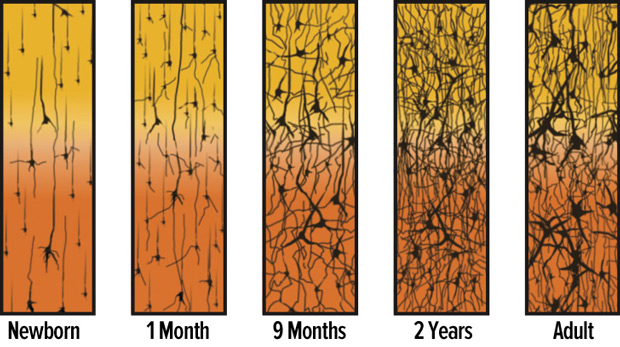
According
to studies, there is a fast increase in synapse density up to 2 years, and from
that point on, synaptic pruning (decrease of synapses) takes place until adolescence.
However, according to the graph above, not all synapses follow the same pattern
of growth or pruning.
It seems
that our capabilities and skills are set until early adolescence. If that is
so, why we are able to learn different things throughout life that were not
presented to us in early development? The only possible conclusion to me was brain plasticity.
It seems that although our synapses are
pretty much the same through adulthood how they respond to stimulus might
change. Also, microglia (specific cell type in the brain that work in the
immune response as well repair) seems to play an important role in brain
modulation.
I would
like to know more about it, whether microglia helps in neurogenesis in
adulthood or if that reactivates paths that were cut during synapse pruning.
I remember
as a child I was not much into physical activities. Sports and things that would require physical effort were not easy to me. When I start working I would spend most of
my time in front of the computer. I've worked with IT for over 10 years.
However, in
the last 3 years my husband, who is very athletic and great at sports,
introduced me to a number of outdoor activities and workouts. It turned out that I’m
actually good at that. It was like I always had it in me but it was hidden. I’m wondering if this is because I already had the pathways for that or
if this is just a modulation of my brain to the new situation.
Thursday, April 10, 2014
Absolute Truth
What caught my attention in the material for this
week was really the article "The Identity Dance" by Gunjan Sinha.
Coincidentally, I studied two other articles, for different classes, about
gene, environment and phenotype. The first article was "Finding New
Laws" by Dr. Pawan Kumar Dhar and it was published at Nature
Magazine, (http://www.nature.com/nindia/2011/110309/full/nindia.2011.35.html).
In this article, Dr. Dhar explores the Mendelian Laws in the light of the
great variation of phenotypes observed in nature for the same genotype. He
concludes then that new laws are necessary to be created because the Mendelian
Laws were based on elementary mathematics. Mendel artificially excluded
the noise in his samples in order to create a pattern or a constant. However,
if all variables that can influence the phenotype are added - which
includes the environment- then, the result is more complex and could be better
identified under statistical laws.
The second article, titled " A Higher Mutational Burden in Females Supports a ‘Female Protective Model’ in Neurodevelopmental Disorders" (http://download.cell.com/AJHG/pdf/PIIS0002929714000597.pdf?intermediate=true ) explored the direct relationship between gene and neurodevelopmental disorders (ND). It covered the association with deleterious CNV (copy number variants) and SNV (single nucleotide variant) as the cause of NDs. The authors concluded that females have more deleterious CNVs and SNVs than males which supports the theory that females have a protective model against NDs - the idea is that females need more mutations than males to express the disorder.
Those three articles are basically tackling the same subject: the relationship among gene, environment and phenotype (the expression of certain characteristic) -by the way, identical twins are not genetically identical. Due to copy number variants, which are mutations, twins differ quite a bit. Mutations can happen during mitosis or meiosis, so even though twins could be genetically identical when they were born, while they grow up (mitosis) mutations happen.
It is said that the phenotype is the result of the interaction between genotype and environment, but what is the weight of each one in the phenotype, it seems to be unknown. For example, one could argue that identical twins have different behavior because they had different life experiences and therefore it trigged different genes to express the behavior. Likewise, someone could say identical twins are different due to copy number variations, and therefore express different behaviors even if they seem to go through the same life experiences.
I think the debate Nature vs Nurture is not over, but we might be close to understanding that there is no absolute truth about genotypes and phenotypes. As Dr. Dhar suggested, we are more likely to find trends other than absolute correlations.
Subscribe to:
Posts (Atom)